



The past five years have seen tumultuous shifts in business operating environments, marking a transition from volatile, uncertain, complex and ambiguous (VUCA) to brittle, anxious, non-linear and incomprehensible (BANI), a term coined by US futurist Jamais Cascio in 2020.
Cascio argues that new paradigms require new language [1]. BANI offers a new lens through which to explore chaotic situations that are simply too much to process.
Social isolation arising from prolonged lockdowns has normalised conspiracy theories that are amplified by continuous online misinformation and disinformation. Wars in Ukraine, the Middle East and Africa and persistent economic uncertainty have accelerated a rise in popularity of autocratic leaders, exacerbating widespread societal discord. Mistrust is now commonplace and there’s no shortage of existential crises demanding urgent attention.
All of this has inevitable consequences for the way work is undertaken.
To be expected, the frequency and scale of novel events is confounding boardrooms across the spectrum. There isn’t an executive education programme out there that could have adequately prepared us for the slow disintegration of the sophisticated global infrastructure that has for so long enhanced human life.
How does anyone adequately respond to failing economic, political, societal and environmental systems?
Unable to make sense of the inexplicable, the default human response is almost always fear. All too often this plays out as reinforced efforts to control that which one perceives to be controllable.
A September 2025 article [2] revealed a third of UK employers now use employee monitoring software – ‘bossware’ – to track the movements of their staff. Insisting people return to the office, adopting increasingly illiberal methods of workplace surveillance and prioritising productivity over all other metrics of success are just a few examples of reinforced efforts to command and control work practices.
But dogmatic leadership is counter-productive, not least because of the pace at which it erodes trust.
As workplace AI goes mainstream and all business planning activity focuses on a return to economic stability and growth, business streamlining is once again a primary boardroom agenda item. The ever-present threat of redundancy is fuelling widespread fear, stress, anxiety and burnout throughout working populations.
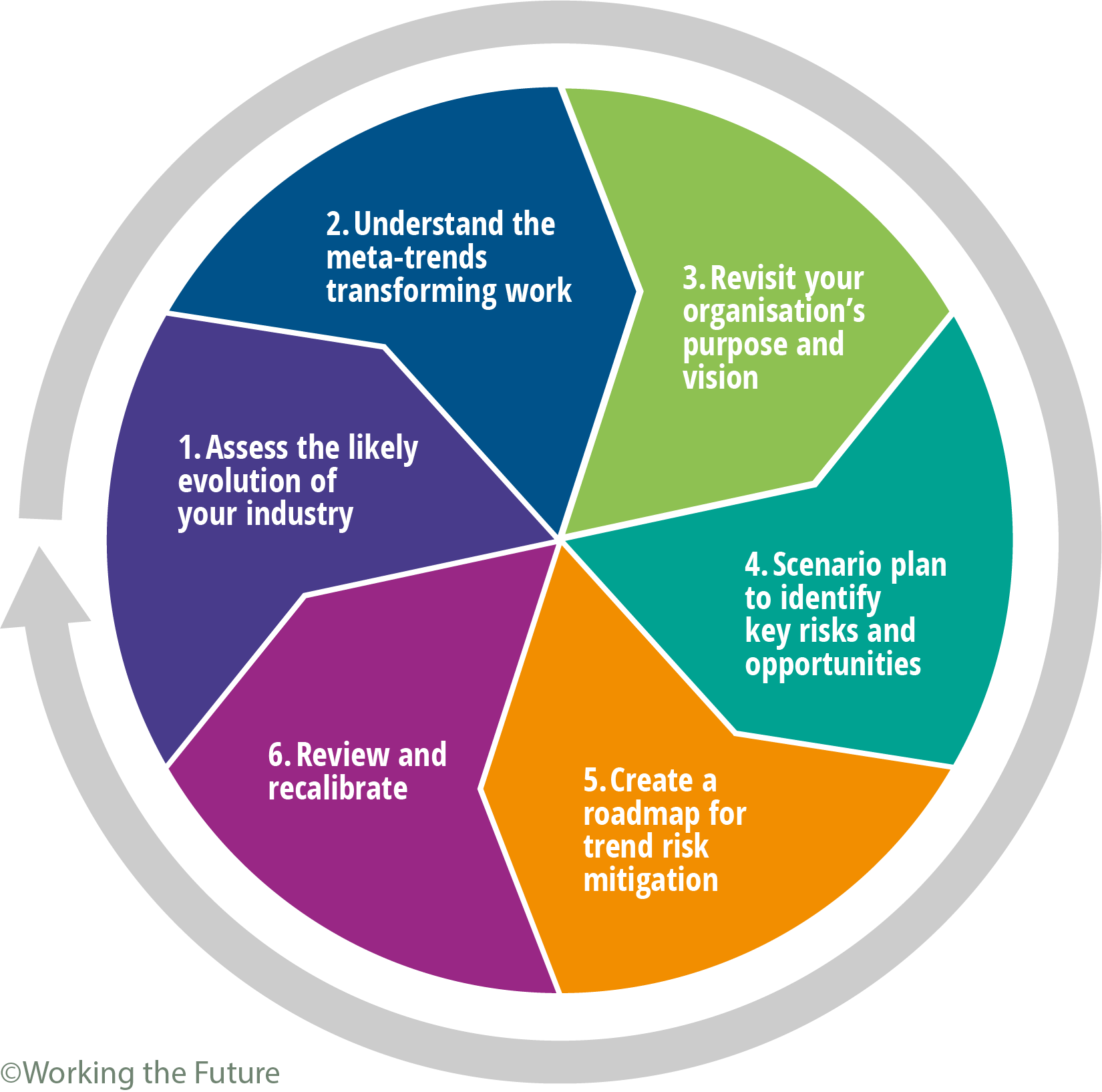
But what if there is another way?
What if, instead of doubling down on conventional business thinking, leaders were to get curious, creative and experimental?
What if, instead of assuming superior know-how, they were to facilitate all-hands conversations to harness group intelligence and explore a wider range of perspectives?
Getting curious about what might be, instead of trying to control what is, is where innovation and transformation happen.
But before any of this can happen, everyone on the team needs to understand the overarching goal of the business and the value it creates in the world. Unfortunately, research shows this isn’t always the case.
The 2024 IC Index [3], produced by the Institute of Internal Communication showed only 50% of those surveyed were clear on their organisation’s strategy, understood how progress was being made and their personal contribution in delivering against business goals.
In today’s landscape, making sure everyone within the organisation has business acumen – which includes depth understanding of industry trends and developments – is a primary source of commercial resilience.
Going a step further, understanding the multiple, interconnected trends causing workplace disruption builds awareness of the situational factors impeding business performance. Trend analysis and interpretation enhance systems-thinking and are core components of successful risk mitigation and long-term business sustainability.
In short, you can’t plan for the future of your business if you aren’t aware of the reality of your operating landscape.
Work trend analysis is integral to successful business planning
We split work trends into two camps.
There are the macro-trends – real-world situations and events happening at a global scale, which scant few organisations have influence over. These include the proliferation of AI and other new technologies, the escalating climate crisis, rising geopolitical frictions, burgeoning attention disruption and more.
And then there are socio-cultural trends. Labour markets are evolving rapidly, driven by factors including ageing populations, shifting attitudes to work, a reskilling emergency, increases in agile ways of working and the rise of next-generation talent ecosystems.
Given the level of business disruption arising from HR and people-related issues since COVID, these trends simply can’t be ignored.
Since 2020, there has been a seismic uptick in the number of economically inactive people, increased demand for remote, hybrid and more flexible ways of working, a widespread erosion of trust, persistent low engagement, and rising stress, anxiety and burnout. Anger and activism are escalating in response to societal inequality and social injustice.
Understanding these trends is key to any successful strategic workforce planning. And any organisation relying on human contribution for product and service innovation must have a strategic workforce plan.
+ + + + + + + +
Scroll down for details on how we can help you to take account of the future of work in your business-planning process.
+ + + + + + + +
What is strategic workforce planning?
Given the current extent of labour market flux, a strategic workforce plan is a crucial cornerstone of business planning and future preparedness.
Strategic workforce planning helps organisations align their people with current and future business goals. It requires deep knowledge of existing workforce capabilities and a forecast of future skills needs. With this information, plans can be developed to make sure the business has the right mix of skills and competencies available at the right time, to deliver optimal results.
A strategic workforce plan integrates:
- Understanding of current skills and competencies within the business alongside an appreciation of their vulnerability to automation and how those skills and competencies may evolve
- Understanding of current labour market trends
- Understanding of the full range of employment contract types
- Identification of mission-critical skills and on-demand skills
- A reskilling and upskilling plan
A viable strategic workforce plan must encompass a plan for the future of work. Responding to the undercurrents transforming the way work is undertaken is foundational to long-term business resilience.
What is a future of work strategy?
A future of work strategy is a plan to adapt to emergent workplace trends and prepare for how work will be undertaken in decades to come.
Done well, it equips businesses with the insight to create adaptive responses to anticipated future events. Using applied tools and techniques, it typically includes:
- Understanding of the long-term strategic vision of the business
- Understanding of the trends disrupting work
- A plan outlining how automation, AI and other digital tools will integrate with human input
- A plan for workforce transformation showcasing how the business will hire and develop future skills and adapt to shifting expectations towards work and careers
- A plan for future workplace design that optimises for both on-demand and distributed working and in-person gatherings that underpin successful collaboration
- A plan for agile and market responsive ways of organising
- A strong focus on culture and team dynamics
Traditional business-planning activities typically include some industry and market SWOT analysis, an evaluation of current and future products and services, a sales and marketing strategy refresh and financial projections for the year ahead. Today’s ambitious organisations are however now going further and devising future of work plans that integrate with their business plan.
Three key reasons why a future of work strategy is important
There are many reasons why any business hoping to survive the coming decade needs a future of work strategy. These include:
- Digital disruption: The World Economic Forum’s 2025 Future of Jobs report predicted 39% of existing skillsets will either be transformed or become irrelevant in the next five years. Those with the most sought-after skillsets will have no shortage of opportunity to choose from.
- Skills shortages: The war for talent is far from over. The same WEF report predicts 59% of workers globally will need upskilling by 2030. Creating the conditions for people to safely experiment, learn and innovate in the flow of work is both attractive to ambitious professionals and vital for organisational future-proofing.
- Agility is competitive advantage: In today’s molten commercial landscapes, no organisation can afford to be slow or worse, unresponsive, to shifts in market demand. Business must find new ways of structuring work – something HR futurist Perry Timms refers to as polymorphic organising [4].
Conclusion
In the current economic climate, no organisation can afford to stand still. Doubling down on command-and-control is not a strategy. Ambitious modern workers crave agency, flexibility and work that prioritises continuous learning, growth and skills development. Reinforcing overly didactic operating conditions stymies engagement, flourishing and ultimately, innovation.
Instead, imagination, curiosity, empathy and experimentation are transformation superpowers.
Understanding the market forces at play, observing the way they intersect and converge to create dynamic operating conditions is imperative for any ambitious future-focused business. Integrating foresight into business planning activities is key for risk mitigation and to leverage opportunity.
Creating a future of work strategy is a proactive futureproofing measure that enhances business resilience and demonstrates both preparedness and ongoing recognition of the power of human potential in delivering exceptional commercial outcomes.
References:
- https://medium.com/@cascio/facing-the-age-of-chaos-b00687b1f51d
- https://www.personneltoday.com/hr/a-third-of-uk-employers-use-bossware-to-track-staff/
- https://www.ioic.org.uk/resource/ic-index-2024-report-trust-issue.html
- https://pthr.substack.com/p/polymorphic-organisations
+ + + + + + + +
Business transformation isn’t the latest software or project tool. Lasting organisational change happens conversation by conversation...
So, if you’d like to explore anything we've touched on in this blog or discuss any other aspects of the future of work and how it fits in to your business planning, please do get in touch.
You might also want to: